Strategic Asset Recovery: Navigating the 2026 Industrial Supply Chain Pivot
- News
Are You Shopping Industrial Equipment Right Now? If you are, be prepared for more challenges than planned: material costs continue to escalate across metals, electronics, and components; suppliers fail to deliver as promised, and lead times keep growing quarterly; and technology cycles shorten, prompting faster upgrade decisions than planned: this is now your operating environment as an industrial equipment buyer.
The Bureau of Economic Analysis recently reported that US manufacturing output continues to expand, creating more demand for machines, tools, and other production assets as demand rises and availability decreases. Your responsibility has expanded. You are no longer focused only on finding competitive pricing. You also manage uptime, maintenance schedules, inventory levels, and long-term capital planning as part of the same equation.
New equipment requires significant capital and often takes months to arrive. At the same time, older equipment sits idle in storage, losing value with every passing quarter. Strategic asset recovery provides a better alternative.
What Is Strategic Asset Recovery?
Strategic asset recovery involves identifying equipment you already own but no longer use and converting it into value. That value may come through redeployment within your operation, refurbishment to extend life, or resale into the secondary market. Instead of allowing assets to sit unused and depreciate, you actively manage their lifecycle.
In 2026, strategic asset recovery is no longer a side initiative. It has become central to smart procurement and financial planning for industrial equipment buyers and used industrial equipment buyers.
It supports procurement teams by:
- Reducing idle asset write-offs.
- Improving budget predictability.
- Creating alternatives to long lead time purchases.
Instead of absorbing losses on idle equipment, you recover costs and reduce unnecessary purchases.
Your Role in Supply Chain Stability
You sit at the intersection of supply and demand. Your decisions influence production timelines, maintenance windows, and inventory exposure.
- Your actions directly affect:
- Plant uptime and throughput.
- Maintenance coordination.
- Inventory carrying costs.
In an unstable market, your role shifts from transactional buyer to operational stabilizer.
You create stability by:
- Diversifying suppliers across regions to minimize disruption risks.
- Planning inventory carefully so as to prevent both downtime and excess stock accumulation.
- Tracking asset lifecycle data including condition, performance, and usage analysis.
When procurement aligns with asset recovery strategy, supply chains become more resilient and reliable for industrial equipment buyers.
What’s Changing in 2026
Supply chains continue their journey toward nearshoring, automation, and digital transparency.
These shifts change how you evaluate suppliers and assets:
- Faster fulfillment of expectations.
- Higher reliance on performance data.
- Greater accountability for sustainability metrics.
These changes directly affect how you source and manage industrial surplus equipment.
Speed now matters more than distance. Fast, reliable delivery outweighs low unit cost.
Data drives decisions. Usage patterns, maintenance records, and performance metrics inform what you buy.
Sustainability expectations increase. Reusing industrial surplus equipment reduces waste and supports environmental standards.
Early adaptation allows industrial equipment buyers to control costs while keeping operations stable.
How to Make Asset Recovery Work
Asset recovery only delivers value when supported by a clear process.
Without structure, recovery efforts often fail due to:
- Incomplete asset records.
- Unclear ownership across departments.
- Delayed decision-making.
Unify all assets into one view. Conduct regular audits to check what exists and its performance. Create central records so decisions can be made faster.
Sort industrial surplus equipment according to the recovery path. Determine high-demand items for resale or redeployment as well as obsolete machines for parts recovery or recycling.
Make use of digital platforms. Online marketplaces connect you with verified used industrial equipment buyers and enable faster liquidation while offering transparent pricing structures.
Refurbish when economics permit. Preventive maintenance, component replacement, and testing extend asset lifespan and delay capital purchases.
Link procurement to recovery data. Let recovered asset insights guide future buying, prevent duplicate purchases, and document savings from reuse.
This approach creates a closed-loop system between procurement and recovery.
Why Industrial Surplus Equipment Matters
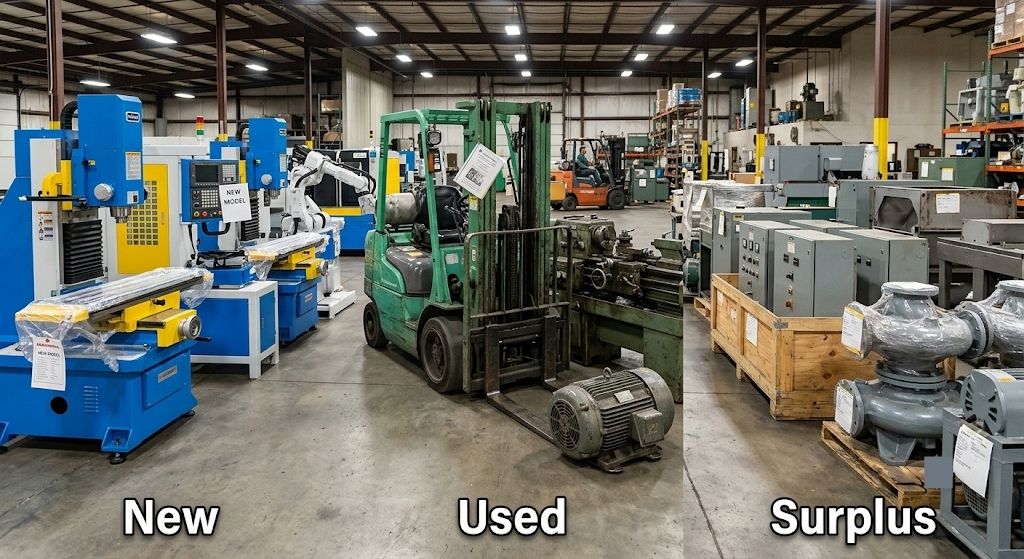
Companies upgrade equipment more frequently than before. This creates more surplus across industries.
Common drivers include:
- Automation initiatives.
- Technology standardization.
- Facility consolidation.
Stop treating surplus as excess inventory. Treat it as a usable resource.
- Industrial surplus equipment delivers:
- Lower cost compared to new equipment.
- Faster availability than manufacturer lead times.
- Proven performance from known operating histories.
For industrial equipment buyers, surplus provides flexibility and reduces exposure to extended lead times. It also creates opportunity for used industrial equipment buyers seeking dependable alternatives.
The Real Impact of Recovery
Strategic asset recovery delivers both financial and operational benefits.
Those benefits include:
- Faster access to usable equipment.
- Lower reliance on emergency purchasing.
- Improved coordination between procurement and maintenance.
- Financially, it frees cash tied to idle equipment. Operationally, it allows faster response to production needs without waiting on new deliveries.
You also reduce storage costs and improve space utilization. Over time, recovery strengthens inventory discipline and improves procurement outcomes for industrial equipment buyers.
What You Need to Know
- Manufacturing growth increases pressure on procurement teams.
- Strategic asset recovery improves cash flow and equipment utilization.
- Industrial surplus equipment reduces wait times and sourcing risk.
- Industrial equipment buyers who integrate recovery build stronger supply chains.
Getting Ready for 2026
Strategic asset recovery has become essential in today’s supply chain environment. To navigate ongoing disruption, recovery must become a top priority for industrial equipment buyers. It helps lower costs, manage inventory efficiently, and remain flexible while controlling capital exposure.
Buyers who manage industrial surplus equipment effectively achieve faster sourcing and stronger financial returns. As supply chains evolve, companies require partners that understand both procurement and recovery.
At VB Industrial Supply, we support industrial equipment buyers and used industrial equipment buyers with smarter sourcing strategies, structured asset recovery programs, and reliable industrial surplus equipment solutions.