How to Sell Excess MRO Inventory: A Guide for Maintenance and Plant Managers
- News
Every maintenance storeroom has a shelf nobody likes to talk about. It holds motors from a retired line, valves ordered "just in case," and boxes of sensors no one has touched in years. If that sounds familiar, you have options. Fortunately, knowing how to sell excess MRO inventory is the solution that will not only give your company an extra stream of revenue but also make the physical inventory less of a burden. This guide covers what surplus parts are, why they pile up, how to prepare them, and how the selling process works from start to finish.
What Is Excess MRO Inventory?
MRO stands for maintenance, repair, and operations. It covers the spare parts and supplies that keep a plant running but never become part of a finished product. Excess MRO inventory is any of those items that your facility no longer needs. These are parts with no planned use, no matching equipment, or quantities far beyond what your team will ever consume. The parts are often brand new, unused, and still in original packaging. They simply have nowhere to go.
Why Companies End Up With Excess MRO Inventory
Surplus rarely comes from one bad decision. It builds up through normal business changes:
- Equipment upgrades: New machines will render your old spare parts obsolete and make redundant your old inventory.
- Plant closures: If a site is closed, it is common that entire warehouses are abandoned behind with the stock still inside.
- Overstocking: Buyers order extra to avoid downtime, then never use it.
- Equipment replacement: Parts from retired machines will be left because nothing else takes their place.
- Changes in production: A change in either product or production process makes specific parts out of date.
- Old or obsolete equipment: Accessories of old machines remain unused for a long time.
- Facility consolidation: Merging different production units leads to unnecessary inventory.
Any of these situations can be the right moment to consider MRO inventory liquidation instead of letting parts collect dust.
What Types of MRO Inventory Can Be Sold?
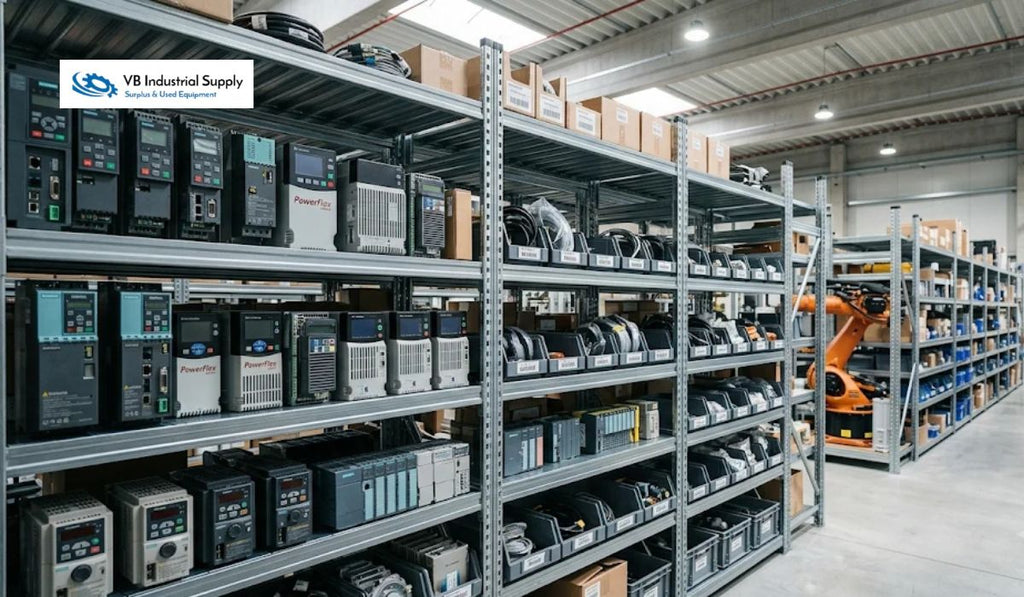
You can sell excess MRO inventory in almost every category found in an industrial storeroom. The most common include:
- Bearings
- Motors
- Pumps
- Valves
- Electrical components
- PLCs
- Sensors
- Drives
- Tooling
- Pneumatic and hydraulic parts
Name-brand automation and electrical items tend to draw the most attention from MRO inventory buyers, but even mixed lots of general maintenance parts can find a home. If it was bought for plant maintenance and it is still in good shape, it is worth asking about.
How Excess Inventory Creates Costs
Unused parts are not free just because they were already paid for. They cost you every month they stay on the shelf:
- Storage space: Shelving, racks and floor space are all scarce resources, and leftover parts occupying these take up the space required for the actively used parts.
- Inventory management: It needs labor to count, move, and record these items besides the fact that they must be accounted for, and someone has to do that.
- Aging and obsolescence: Parts lose value as technology moves on, and some deteriorate in storage.
- Capital tied up in unused parts: Money stuck in stock can't be used as an investment in projects that matter today.
- Difficulty tracking old stock: Outliers in inventory management lead to confusion over actual stock quantities, making it very hard for you to accurately answer the question "what you actually have?".
The sooner you sell MRO surplus, the more value you can recover, since demand and pricing for many parts decline over time. Surplus MRO buyers also tend to pay better for items that are still current and in demand.
How to Prepare MRO Inventory for Sale
A little organization up front makes MRO inventory liquidation faster and often improves the offer you receive. Follow these steps:
- Create an inventory list: At first, just a quick spreadsheet outlining the list of all the goods you plan to sell.
- Record the manufacturer: Brand name matters a great deal in industrial resale.
- Record part numbers: Copy them precisely from the item or package, including the spaces and the capitalization.
- Count quantities: Physically verify them instead of relying on old systems.
- Identify condition: It is better to state clearly if an item is new, unused, used, or is being refurnished.
- Take photos: Good pictures of labels and packaging that would show that you actually possess the mentioned item will be greatly appreciated by buyers.
- Separate usable and damaged inventory: Keep working parts apart from anything broken or incomplete.
Plant managers who sell excess MRO inventory with a clean list usually get faster responses and fewer follow-up questions.
What MRO Buyers Look For
Buyers cannot price what they cannot identify. Accurate part numbers let them check demand and current market value. Correct quantities determine the size of the deal. Honest condition notes prevent surprises at inspection, and manufacturer details tell them whether the part is a fast mover or a niche item. Experienced surplus MRO buyers review dozens of lists, so a clear and accurate submission stands out. Incomplete or inconsistent data slows everything down or leads to lower offers.
How the MRO Surplus Selling Process Works
Selling surplus does not have to be complicated. With a potential buyer such as VB Industrial Supply, the procedure follows five straightforward stages:
- Quote: You send your list of what you have left and the buyer uses that to make you an offer.
- Review: You check the quote, ask your doubts, and decide whether the terms that work best for you.
- Shipping: After agreeing, the goods are packed and dispatched to the buyer.
- Inspection: The buyer count and compare the parts received to check the item numbers, quantities, and condition.
- Payment: After inspection, the payment is transferred to you for the approved inventory.
Because inspection happens after shipping, accurate listings matter. When your list matches what arrives, the process is quick and smooth. Working with established surplus MRO buyers also means you deal with people who understand industrial parts and can evaluate them properly. Anyone ready to sell MRO surplus will find this structure easy to follow.
When Should a Company Consider Selling Excess MRO Inventory?
There is no perfect time, but certain moments make the decision easier:
- Before a plant closure: Selling your items before the time of closing protects you from an immediate shutdown and allows for a proper format.
- During facility upgrades: Replaced equipment often leaves behind parts you will never use.
- During inventory audits: Audits reveal slow-moving and forgotten stock that can be sold right away.
- When storeroom space is limited: Clearing surplus makes room for parts your team needs daily.
- When obsolete stock accumulates: Waiting rarely helps, and value tends to drop as parts age.
If any of these apply to your site, it is a good time to sell excess MRO inventory rather than carry it into another budget year. Many teams combine these moments with a planned MRO inventory liquidation so the whole storeroom gets cleaned up at once.
Conclusion
Surplus parts do not have to sit around draining space and money. By understanding why excess builds up, organizing your records, and choosing the right moment, you can sell excess MRO inventory with far less effort than most people expect. If your storeroom has parts that are not moving, gather your list, add photos if you have them, and submit it to VB Industrial Supply for review. Whether you have a single pallet or an entire storeroom, the team at VB Industrial Supply can evaluate it as one of the MRO inventory buyers focused on industrial equipment. Visit vbindustrialsupply.com to get started, and take a quick walk through your storeroom today. You may find more recoverable value than you thought.
Frequently Asked Questions
1. What counts as excess MRO inventory?
Parts for maintenance, repair, and operations inventory, which your facility does not need anymore or is going to use rarely, are excess.
2. Can I sell excess MRO inventory that is used or opened?
Of course! You may even be able to sell used or opened items if you are very clear about their condition. The most important thing to be sure is to provide an accurate description of the item you are selling.
3. Do I need a complete list before contacting a buyer?
While a full list is preferred, you can just send what you've got right now. Prospective MRO inventory buyers can look at your partial lists and continue working with you.
4. How can I sell MRO surplus without disrupting operations?
First of all, isolate the surplus parts from those you still actively use. Then ship it off in well-timed parcels, so the everyday maintenance work remains uninterrupted.
5. Does VB Industrial Supply buy large lots?
Yes., VB Industrial Supply accepts inventory submission from small through large, even entire storeroom clear-outs.