How Distributors and Manufacturers Sell Excess PLC and Automation Inventory
- News
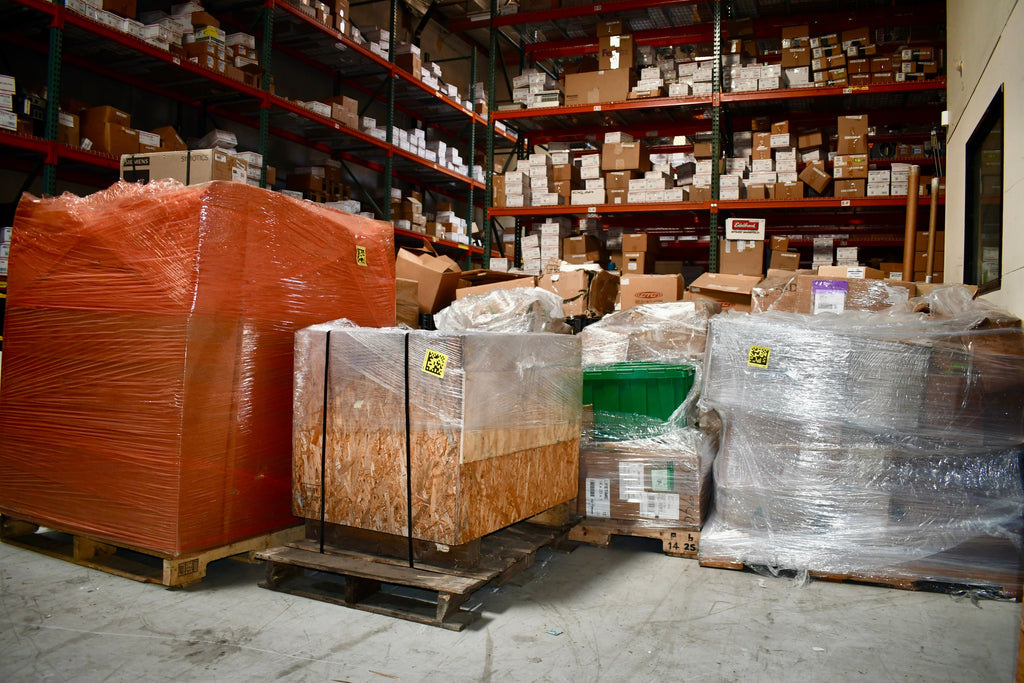
For most of the years I've been in this business, the automation surplus that came through our Ventura warehouse was from plant cleanouts. A line comes down, a facility closes, somebody calls us about the spare parts crib. That still happens. But over the last year, more and more of what we buy comes straight from distributors and manufacturers.
It's stock ordered for a project that got cancelled. Customer returns that can't go back to the factory. The last forty units of a part the manufacturer discontinued. A shelf of SLC 500 cards that nobody has asked about since 2019.
If you run a distribution branch, a regional warehouse, or an OEM stockroom, you already know that inventory is costing you money every month it sits there. This post covers how selling excess PLC and automation inventory to a surplus buyer actually works, and what to expect on price. I'd rather you go in with realistic numbers than get a quote that catches you off guard.
Where excess automation inventory comes from
Almost every distributor and manufacturer we buy from ended up with surplus the same handful of ways:
- Cancelled or downsized projects. The integrator ordered 60 I/O modules for a line expansion, the expansion got pushed to next year, then pushed again.
- Returns past the window. Opened boxes, customer returns after the restocking period, or parts the manufacturer won't take back.
- Line card changes. When a distributor drops or picks up a brand, the old brand's stock has nowhere to go.
- Platform migrations. As plants move from SLC 500 and PLC-5 to CompactLogix and ControlLogix, or from S7-300 to S7-1500, the legacy spares get stranded on the shelf.
- Last-time buys that overshot. Someone bought enough of a discontinued drive to cover five years of customer demand, and the demand lasted two.
- Minimum order overbuys. The customer needed 4, the factory shipped a case of 20.
None of this means anyone did anything wrong. It's just what happens when you stock automation parts. The problem is that none of it moves through your normal channels. Your customers want current product with a factory warranty, and listing old stock yourself on eBay means photos, listings, packing, returns, and a lot of time your counter staff doesn't have.
What we buy from distributors and manufacturers
We buy new sealed, open box, new old stock (NOS), and used automation and electrical parts. One pallet or a whole warehouse. The categories we see most from distributors:
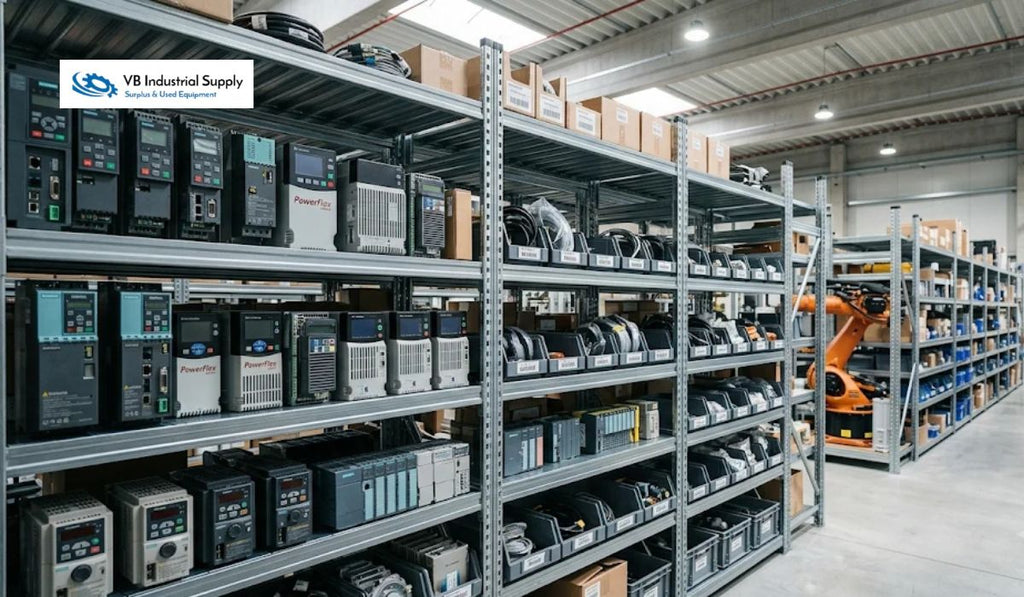
- PLCs and I/O: Allen-Bradley ControlLogix, CompactLogix, SLC 500, Micro800 and Flex I/O; Siemens S7-300, S7-1200, S7-1500 and ET 200; Schneider Modicon M340 and M580; Omron, Mitsubishi, and AutomationDirect
- Drives and motion: PowerFlex VFDs, Kinetix servo drives, SINAMICS, Festo and Yaskawa servo systems, servo and stepper motors
- HMIs: PanelView, Siemens Comfort panels, C-more, Pro-face
- Sensors and connectivity: Keyence, Banner, Turck, Balluff, Pepperl+Fuchs, IFM, SICK, cordsets and IO-Link masters
- Safety: light curtains, safety relays, e-stops, interlock switches
- Control and power: contactors, overload relays, circuit breakers, power supplies, control transformers
- Building automation: Siemens APOGEE and Desigo, Johnson Controls, Distech
You can see the full brand and category list on our Sell Us Your Parts page.
How pricing actually works on surplus PLC parts
This is the part most sellers aren't expecting, so I'll be upfront about it.
The number in your ERP is almost never the number a surplus buyer can pay. Your system shows list price or what it would cost to replace the part. A surplus offer starts from what that exact part sells for on the open market today, new or used, and then accounts for the fact that we have to carry it on a shelf until the right buyer comes along.
Those two numbers can be very far apart. A list we got this year had 1756-CNBR ControlNet modules valued at over $3,000 each. New sealed ones currently sell for under $100, because ControlNet is on its way out and there are hundreds of them listed for sale. That one line was off by about 33 times. It's common for us to receive lots where the seller's total comes in five to seven times what the parts are actually selling for, and nearly every time, the estimate came straight out of a replacement cost column.
What pushes an offer up:
- Current generation parts that are still in demand
- Sealed factory boxes with labels intact
- Complete assemblies or matched sets instead of loose pieces
- Parts that are discontinued but still widely installed, with few units available
What pulls it down:
- Very large quantities of one part number. Four hundred of the same I/O module takes a long time to sell through.
- Legacy platforms with a big supply already on the market
- Conformal coated or special variants that fit a narrower group of buyers
- Commodity items like patch cables and terminal blocks
How the process works
- Send your list. Our asset recovery spreadsheet is easiest, but an ERP or SAP export, a parts list, or photos of the racks all work.
- Get a written offer within one business day.
- Accept the offer. No pressure if it doesn't work for you.
- We handle freight. Prepaid labels for smaller shipments, freight pickup for pallets. We cover the cost.
- We inspect on arrival at our warehouse in Ventura, California.
- You get paid by ACH the same day the shipment is verified.
Questions distributors ask us
Will selling surplus to you compete with my business?
Parts we buy are sold as surplus under the VB Industrial Supply name with our own 60-day warranty. We don't present them as authorized new stock and we don't publish where inventory came from. Most surplus buyers are maintenance techs looking for an obsolete part or trying to get a down line running today, not the contract customers you're quoting. That said, some distributor agreements restrict how and where you can resell a manufacturer's product, so check yours before you sell.
Do you only want the high-value parts?
No. We'll make an offer on the whole lot, so you're not left with a pallet of odds and ends that nobody else will touch.
Is there a minimum or maximum size?
We've bought a single box of spare modules and we've bought full warehouses. If it's industrial automation or electrical, send it over.
Do you buy outside California?
Yes. We buy from distributors, manufacturers, and integrators anywhere in the United States. We've bought lots from Michigan, Wisconsin, Tennessee, and New Jersey.
What about writing off obsolete inventory?
That's a question for your accountant, since it depends on how you book inventory. We can provide documentation of the purchase for your records.
Get an offer on your excess inventory
If you've got PLC, drive, or automation stock that's been sitting on your shelves, send us the list. Call 805-620-0948, email info@vbindustrialsupply.com, or start on our Sell Us Your Parts page. We're open Monday through Friday, 8 AM to 5 PM Pacific.
Dustin
VB Industrial Supply, Ventura, CA